By: Tayyaba Afzaal
Digital Communication and Information Management (DCIM):
DCIM refers to a set of processes, tools, and technologies used to efficiently organize, analyze, and manage digital communication and information within an organization. This concept is heavily related to the role of a Data Analyst as their main job is to clean, organize and present data so that it conveys something that will aid in decision making. Similar to how information is organized and delivered through DCIM, I have used the blog format to convey helpful skills for upcoming data analysts to be better prepared and knowledgeable about the position. My site is dedicated to students and employers alike to learn more about my interests and outlook on the tech world.
What do Data Analysts do?
Data analysts use technical tools to parse large quantities of raw information in order to develop meaningful insights. Data analysts are often responsible for removing corrupted data, determining data quality, and preparing reports. These tasks require data analysts to have well-developed skills in the following areas.
Data Visualization
Data Visualization is presenting data findings via graphics or other illustrations. This aims to facilitate a better understanding of data-driven insights, even for those not trained in data analysis. With data visualization, you can identify patterns and understand complex ideas at a glance, which aid in a businesses decision making.
Data visualization allows you to accomplish more than data analysts traditionally have. “Data visualization is going to change the way our analysts work with data. They’re going to be expected to respond to issues more rapidly. And they’ll need to be able to dig for more insights — look at data differently, more imaginatively. Data visualization will promote creative data exploration” (SAS Insights).
Data Cleaning
Uses & Benefits: An important part of buliding a functional machine-learning model is data cleaning, this usually makes up most of the workload for data analysts (Hillier 2023).
- Staying organized: Businesses collect a lot of information from clients, customers, product users, etc. Cleaning data regularly means keeping it organized.
- Avoiding mistakes: Dirty data doesn’t just cause problems for data analytics. It also affects daily operations. If a database is in good order, the company will have access to helpful, accurate information. If it’s a mess, mistakes are bound to happen, such as using the wrong name in personalized invitations.
- Improving productivity: Regularly cleaning and updating data means quickly purging rogue information. This saves teams from wading through old databases or documents to find what they’re looking for.
With an adequately cleaned dataset, even simple algorithms can generate remarkable insights. In contrast, uncleaned data can produce misleading patterns and lead a business toward mistaken conclusions. Data analysts need proper data cleaning skills to avoid such mistakes.
Python
Learning Python is a top priority for would-be analysts. One poll by the Institute of Electrical and Electronics Engineers’s (IEEE) found that Python ranked second in a list of the top ten programming languages used in work settings in 2023.
Another Statista report lists it as the third most used language among developers worldwide as of 2023. Studies like these convey how widely used and important Python is to a data analyst.
Most used language by developers worldwide:
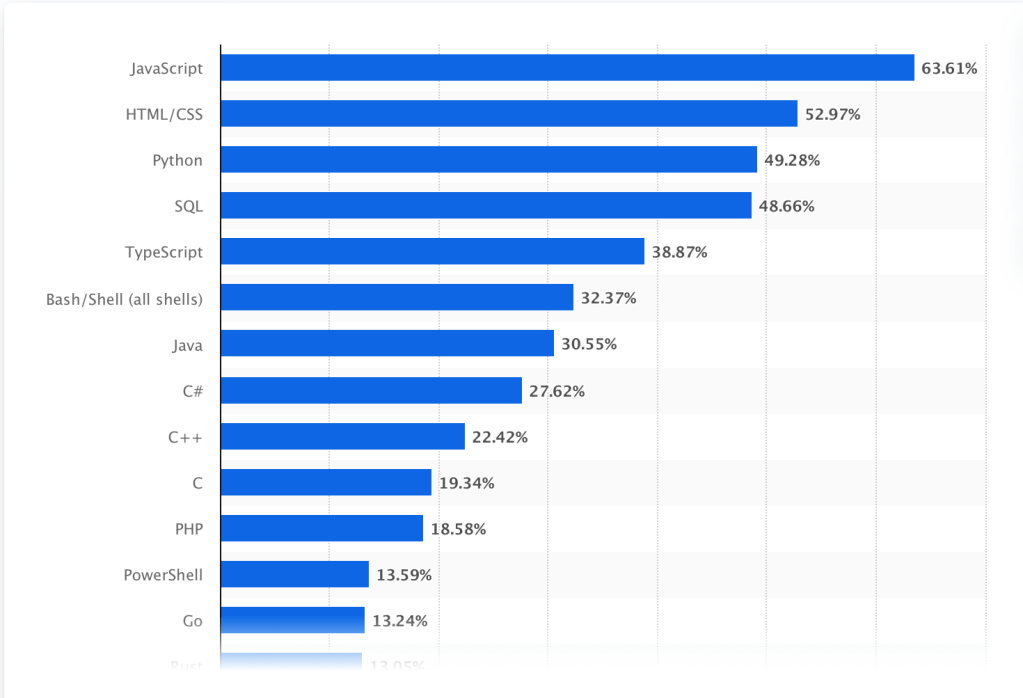
There are many online courses available to attain this skill. Still, there are also many free YouTube videos dedicated to teaching Python, such as the one below from “Programming with Mosh”:
SQL
To break into Data Analytics there are several coding languages you need to be familiar with. This is often a mandatory prerequisite by employers.
SQL was first created in 1970, but it remains invaluable. SQL remains the standard for querying and handling data in relational databases in modern analytics.
SQL’s versatility in interfacing with various data tools and its widespread integration in tools like Talend, Alteryx, Tableau, Looker, and Google Data Studio makes it an essential language for data professionals. Proficiency in SQL is necessary for managing and manipulating large datasets efficiently, facilitating data analysis and transformation across diverse platforms. It enables users to access, update, delete, and add data and perform powerful sorting, filtering, and aggregation tasks swiftly. SQL’s ability to join data sets is crucial for deriving more profound insights from multiple sources and enhancing the analysis of relationships and patterns (Hauer & Deora 2023).
Moreover, SQL’s automation capabilities, including stored procedures, functions, triggers, and views, empower users to automate data processing tasks, saving time and effort. The automation also accelerates time to insights, contributing to the overall decision-making agility of businesses and creating opportunities for career advancement in roles such as solutions consultants or SQL developers.
Microsoft Excel
“Excel skills” frequently appears as a requirement for jobs listed for data analysis. Excel enables users to create charts, graphs, and pivot tables to visualize data and gain insights into trends and patterns.
Excel offers essential tools for data analysis, including pivot tables and charts that transform complex datasets into structured and visually representative information. Conditional formatting enhances the organization of data, creating visually appealing displays. Excel’s dashboards allow for a concise presentation of crucial information. Fundamental functions such as MATCH, LOOKUP, and RANK form the basis for diverse data analysis capabilities in Excel, enabling tasks like data retrieval, error detection, and complex mathematical operations. Excel is also valuable for regression analysis, elucidating relationships between variables, and predicting future connections, facilitated by the Analysis ToolPak add-in, which provides advanced tools for sophisticated calculations ( WGU 2023).
References:
Cass, S. (2023, August 29). The Top Programming Languages 2023 – IEEE Spectrum. Spectrum.ieee.org. https://spectrum.ieee.org/the-top-programming-languages-2023
Features of Excel to Use in Data Analysis. (n.d.). Western Governors University. https://www.wgu.edu/blog/features-excel-use-data-analysis2308.html
HILLIER, W. (2021, November 12). What Is Data Cleaning and Why Does It Matter? Careerfoundry.com. https://careerfoundry.com/en/blog/data-analytics/what-is-data-cleaning/
Python for Beginners – Learn Python in 1 Hour. (n.d.). http://Www.youtube.com. Retrieved January 10, 2024, from https://youtu.be/kqtD5dpn9C8?si=w6EbiJpnuHvOn1sg
SaS. (2019). Data Visualization: What it is and why it matters. Sas.com. https://www.sas.com/en_us/insights/big-data/data-visualization.html
Statista. (2022). Most Used Languages among Software Developers Globally 2019. Statista. https://www.statista.com/statistics/793628/worldwide-developer-survey-most-used-languages/
Why SQL is a must-have skill for every data analyst | Blog | Fivetran. (n.d.). http://Www.fivetran.com. Retrieved January 10, 2024, from https://www.fivetran.com/blog/why-sql-is-a-must-have-skill-for-every-data-analyst#:~:text=SQL%20presents%20a%20simple%20and

 TayyabasPortfolio